

As the majority of my readers own a smart phone (up to 95 percent in some countries) I’ll assume I’m speaking to an audience with lived experience in the field of persuasion technology—the attention grabbing applications that consume an unhealthy proportion of our time. Before we start, let us establish who is responsible for these addictive behaviours. Each of us shares, with all other mammals, a common neural blueprint that has been explored and exploited by software designers since the early 2010’s. This endeavour led to the creation of a new job designation, the neuroeconomist, an interdisciplinary expert in neuroscience, psychology and economics who helps organizations realize greater financial returns through their understanding of human motivation.
The Role of Dopamine in Motivation
This field of expertise is rooted in our understanding of the neurotransmitter dopamine and its actions on the brain’s incentive and reward pathway. The neuroeconomist’s mission is to maximize the financial benefits that accrue to their clients by enhancing the addictive qualities of their products. This effectively puts them in the driver’s seat of our brains and absolves us of responsibility for our phone-related addictions.
Two early adopters of this model are neuroeconomist Dalton Combs and neuroscientist Ramsay Brown. A major feature of their approach to software design is in maintaining the fast pace of rewarding actions. This utilizes a feature of the addiction process observed consistently in the abuse of chemical agents: the potency of a dependency depends on the speed of the delivery mechanism and the frequently with which it is administered.
To give them credit, Combs and Brown took the negative impacts of this approach to heart when designing the Mindfulness app Space. Space introduces delays in the app browsing experience aimed at breaking the dependency on the fast-paced dopamine feedback process. Following the release of Space, Dopamine Labs (subsequently renamed Boundless Mind) was purchased by Arianna Huffington’s Thrive Global. Thrive’s mission is to use the exact same psychological levers neuroeconomists employ to generate revenue but reorient them towards ending the stress and burnout epidemic and promoting healthy lifestyle choices. This was a complete inversion of Combs and Brown’s original intent and a major contribution to the wellness industry. This historical narrative reveals that both the negative and positive effects of these limbic exploits are common knowledge in the software industry.
Understanding Reward Prediction Error Coding
The principle underlying the allure of social media and other products like gambling and gaming platforms is reward prediction error (RPE) coding. We might believe that the decisions we make throughout the day are rational outcomes based on logic and reason, and there is some truth to that claim. But operating beneath conscious awareness is the dimension of feeling, in which we take actions that are guaranteed to maximize dopamine flow.
This cycle is surprise based and has three phases:
- If we perform a task and the emotional response we receive is less enjoyable than expected, we are likely to abandon those activities.
- If life becomes too predictable (we get only the reward we expect) and we receive little or no emotional lift from our actions, we are less likely to continue with those activities, but do not necessarily discontinue them.
- Should we take an action and something unexpectedly funny, enjoyable or satisfying happens, we are likely to repeat that activity hoping for the same reward next time we try it.
RPE coding is a fundamental learning mechanism by which mammals, including humans, use differences between expected and actual rewards to identify and reinforce behaviours most likely to produce beneficial outcomes.
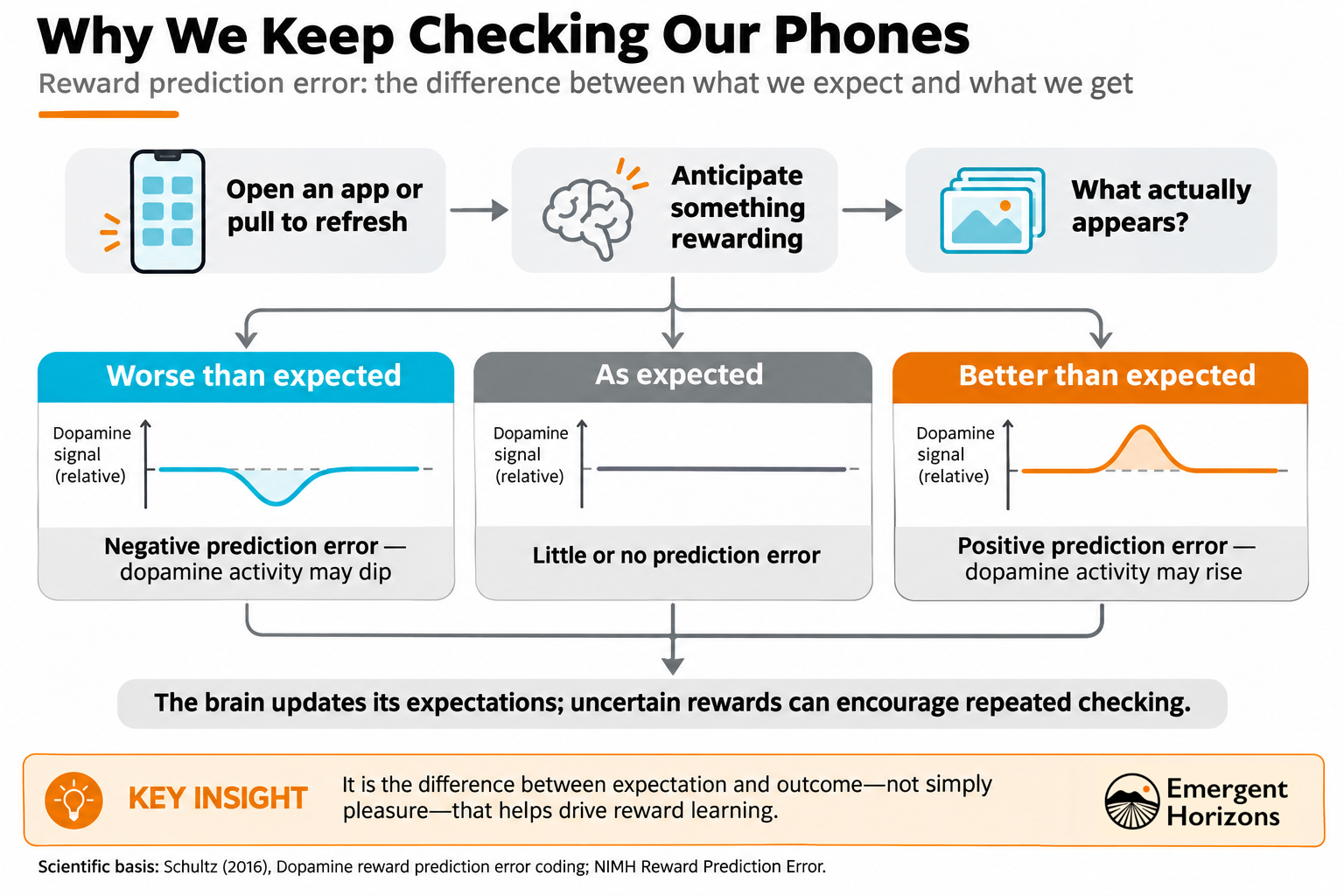
Social media apps can exploit RPE coding by creating unpredictable opportunities for reward. Initially, entertaining content establishes an expectation that opening the app will be rewarding. Algorithms then deliver a mixture of ordinary and highly engaging content, making the next reward uncertain. When something unexpectedly interesting appears, a positive prediction error can strengthen learned associations between the app and rewarding experiences. Over time, notifications, scrolling, and other cues can trigger anticipation and motivate repeated checking. Combined with reward uncertainty and habit formation, these mechanisms can sustain engagement even when users derive little pleasure from the experience.
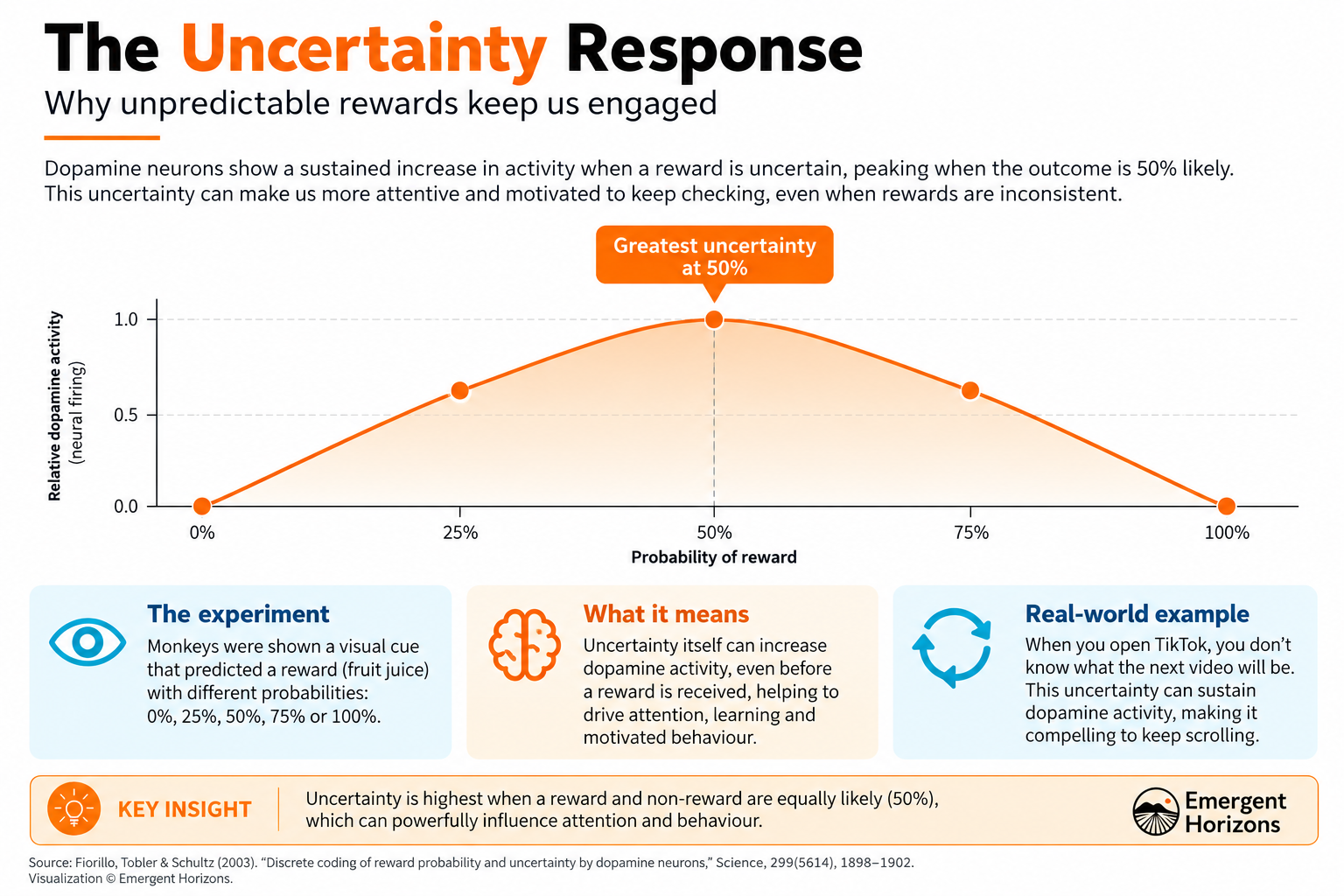
The relationship that dopamine levels have with reward is sometimes counterintuitive, however. The dips and bumps presented in the graph above relate to phasic (short term) dopamine activity relative to a baseline, whereas reward uncertainty can produce a more sustained increase in dopamine neuron activity during anticipation. The research of Fiorillo, Tobler and Schultz revealed that dopamine activity continued to increase (to a point) even when there was no immediate reward, showing that motivation and learning are not directly tied to the expected benefits, depending on the timeframe. Our internal dialogue might convey well that was disappointing; I won’t bother doing that again, but the same disappointing circumstance might also give rise to losing made me need to win. If we continue to compulsively pursue activities we no longer enjoy, the time has probably come to question our behaviour.
Addressing the Risks of Smartphone Use
Now that the science behind phone addiction and its associated harms are more broadly understood, regulators are starting to take action. Governments are beginning to recognize the risks associated with technologies designed to maximize user engagement. Excessive smartphone use can undermine our mental and physical health, disrupt sleep, impair concentration, strain relationships, and diminish our capacity to engage meaningfully with the world around us. Particularly among adolescents, problematic smartphone and social media use has been associated with increased risks of depression, suicidal ideation, and, in the most tragic cases, suicide, although a direct causal relationship has not been established.
In February 2026, the European Commission preliminarily found TikTok in breach of the Digital Services Act, citing addictive design features including infinite scrolling, autoplay, and algorithmically personalized recommendations. Similar findings followed against Facebook and Instagram in July. In Canada, the proposed Safe Social Media Act explicitly identifies endless scrolling and engagement-based feeds as potential sources of harm, particularly for young people. These developments reflect a growing recognition that problematic smartphone use cannot be addressed solely through individual self-discipline. The design of the technology itself must also be examined.
Escaping the Trigger-Action-Reward Cycle
Given a sufficiently extended timeframe, the effects of the trigger-action-reward cycle exploited by social media apps are moot. After becoming encoded in the brain, the expectation of reward provided by an activity loses its importance and the behaviour may persist because the individual has become habituated. This is the point where attention to the costs and benefits of the activity becomes more meaningful. The question might arise: is the time we are investing in our process behaviours worth the productivity, energy and intimacy we lose because of them?
These situations benefit from a compassionate and nonjudgemental approach to behavioural change by asking neutral questions that explore our circumstances without shaming or condemning. Suitable inquiries might include:
- What am I feeling immediately before I reach for my phone?
- What am I hoping to find?
- What happens if I wait thirty seconds before checking?
- Am I seeking connection, stimulation, reassurance, or relief?
At Emergent Horizons we believe that by understanding the mechanisms underlying our own subjective experiences and approaching them with curiosity we can move beyond them into a more peaceful and sustainable way of living.
Related articles: Porn Addiction: What's Really Going On?


0 Comments