

Rather than defining problematic pornography use as an addiction, contemporary diagnostic frameworks take a more conservative approach. The American Psychological Association's Diagnostic and Statistical Manual of Mental Disorders (APA DSM-5) does not recognize pornography addiction as a distinct diagnosis. Meanwhile, the World Health Organization's International Classification of Diseases (ICD-11) recognizes Compulsive Sexual Behaviour Disorder (CSBD), which it classifies as an impulse control disorder, rather than an addiction, that can manifest through problematic pornography use (PPU) and other repetitive sexual behaviours.
Their approach is a conservative one to avoid pathologizing normal human sexual behaviours. To this end, the APA defines a single behavioural addiction—gambling—and the WHO identifies only two—gambling disorder and gaming disorder. These types of behaviours, which persist despite significant negative consequences, are also known colloquially as process addictions. While the term addiction has a specific use and application in establishing formal diagnoses, such as those described in the DSM 5 and ICD-11, the general public is free to speak of PPU and CSBD as addictions, and much of the discussion does just that.
Alongside PPU, habitual behaviours as mundane as nail biting (onychophagia), and skin picking (excoriation disorder) can share the same mechanisms of habit formation, reinforcement, emotional regulation, and impaired inhibitory control, despite having very different motivations and consequences. Those who engage in PPU are judged much more harshly than those who bite their nails, even though the habit-forming processes of both behaviours are essentially the same. Using a process of compassionate inquiry allows us to set aside our moralistic impulses and approach the issue in an observational rather than critical manner. This reveals the basic human need underlying the dysfunction.
Understanding fundamental human needs
Shame and vulnerability researcher Brené Brown emphasises the importance of human connection in our daily lives:
“A deep sense of love and belonging is an irreducible need of all people. We are biologically, cognitively, physically, and spiritually wired to love, to be loved, and to belong. When those needs are not met, we don't function as we were meant to. We break. We fall apart. We numb. We ache. We hurt others. We get sick.”
Obviously sexual intimacy falls within the scope of this rubric. Rather than being dysfunctional in itself, our attraction to pornographic content is an expression of the very drives that establish connection with our romantic partners and ultimately perpetuate the human race. But meaningful relationships are not easily established or maintained, and people adapt differently to deprivation, distress, rejection, loneliness, and other difficult experiences that emerge in the relational context. PPU might emerge, for some, in response to the breaking, falling apart, numbing and aching that materialize when relational needs go unmet.
Why pornography can become an attractive coping strategy
Pornography is accessible, predictable, and provides both immediate gratification and the capacity to temporarily alter emotional states. For some, it may provide relief from loneliness; for others, anxiety, boredom, inadequacy, or distress. The establishment of intimate relationships is a form of attachment that comes more easily to those with the secure attachment style that formed through stable and predictable early relational bonds. Those who had experiences of neglect or abandonment early in life might find entrusting themselves to another to be an unacceptably vulnerable proposition. For such as these, pornography provides escape from the pain of unmet relational needs for which there is no easy solution.
Neglect and abandonment, however, can affect an individual’s sense of self-worth because they blame themselves for the outcome: I was not lovable enough, important enough or engaging enough to deserve the love and attention afforded to others. These beliefs make it harder to meet relational needs naturally and contribute to the self-judgement and shame experienced in response to PPU. In this, the relationship we have with ourselves is as important as those we have with others.
Good self-esteem is not a pathology like narcissism. In reality it is one in which a healthy physiological and mental balance is established between the individual’s reward/motivation/reinforcement mechanism and its complimentary threat/stress/survival system. In the absence of healthy self-regard, PPU can provide a powerful means of escaping stress and obtaining reward, but as with most addictive behaviours it can produce the opposite effect in the long run by promoting feelings of guilt, shame, regret and a host of other negative emotional states.
What do CSBD and PPU have in common with substance use disorders?
The rewards we experience through meeting our relational needs, particularly those associated with Eros (romantic or erotic love), involve the activity of several naturally occurring brain chemicals. These chemicals help shape our experiences of pleasure, attraction, motivation, and emotional connection. Interestingly, many psychoactive drugs affect these same chemical systems, sometimes producing effects that resemble or amplify aspects of our natural experiences. The following table identifies some of these chemicals and the drugs that influence them.
| Brain chemical | Drugs that affect it (partial list) |
|---|---|
| Serotonin | MDMA (ecstasy), cocaine |
| Norepinephrine | MDMA, cocaine, amphetamine |
| Beta-endorphin | Alcohol, codeine, morphine, heroin |
| Dopamine | Cannabis (marijuana), cocaine, amphetamine, heroin, MDMA |
| Oxytocin | MDMA |
These substances influence the brain's natural chemical signalling in different ways. Some increase the activity of particular chemicals, while others imitate their effects or alter how they work.
These compounds are involved in the rewarding states we experience as attraction and attachment. These are the instincts that underlie the feel-good experiences sought by those who pursue intimate images and videos, feelings that provide escape from challenging mental states. The exact mapping between these chemicals and the subjective relational experiences they awaken have not yet been codified in the research, but there is a clear link between drugs of abuse and the emotional states we experience in relationship.
These drugs piggy-back on the biological, cognitive, physical, and spiritual wiring that empowers us to love, to be loved, and to belong. The clearest example of this is likely the naturally occuring “love chemical” phenethylamine which is expressed in romantic attraction, excitement and infatuation. Phenethylamine is the molecular backbone of many drugs, each of which contain additional components which alter their behaviour in various ways. The neurochemical processes (primarily dopamine release) triggered by amphetamine and phenethylamine are virtually identical, although amphetamine produces more persistent effects.
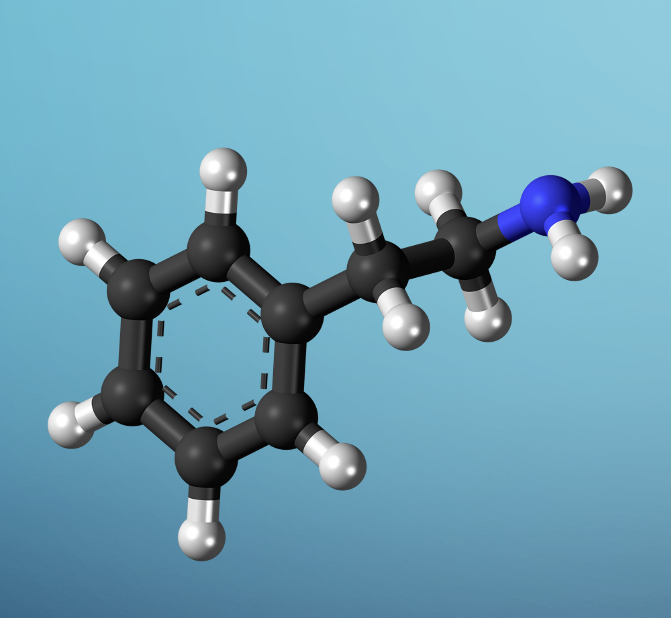
Phenethylamine
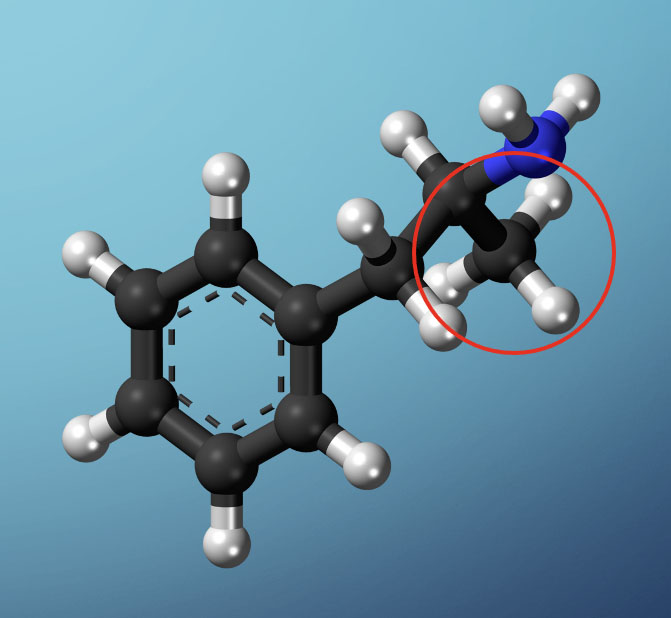
Amphetamine
Comparing Phenethylamine, the naturally occurring "love chemical", with its lab-derived cousin amphetamine. The only difference is the methyl group at the alpha position (circled in red) which block's the body's ability to break it down easily and prolongs its effects. Both compounds activate the same chemical pathway with comparable outcomes. This knowledge reveals the link between amphetamine intoxication and the excitement experienced in attraction, arousal, infatuation, and while engaging with porn.
Repeatedly turning to pornographic images for their mood-altering effects creates a habit that resembles drug addiction because it exploits the same neurochemical systems. PPU can even produce a kind of physical dependence in which the reward system becomes desensitized, and emotional and physical responses become blunted, an effect that is reversed following prolonged periods of abstinence. Thankfully there are no physical withdrawal symptoms associated with this kind of dependence.
Planning for the future
These behaviours are frequently substitutes for unmet relational needs, with the self and others, and can be resolved through an awareness of the underlying deficits and by nurturing self-esteem and self-forgiveness into being. Insecurity, self-loathing and shame likely precede the adoption of these harmful practices rather than merely flowing from them. The key is in resolving limiting beliefs about the self that make meaningful relationships so difficult to establish. This can begin by stemming the negative self-talk and the labels it uses to promote guilt, shame and feelings of unworthiness. The behaviours addressed here are often seen as the solution to these feelings but end up exacerbating them.
There isn’t always a need to seek counselling or therapy when the underlying issues are clearly understood. What is needed is a plan for the road ahead. In most cases this involves a dialogue with a safe person (friend, family member or coach) who provides a non-judgemental ear and facilitates the discovery of solutions rather than enforcing their own.
While this article has made reference to early childhood experience and how that is reflected in the struggles of the present, the goal of the coach is to create a brighter future rather than dwelling on and therapizing on the experiences of the past. If you are ready for this conversation, feel free to reach out for a free consultation.
Related Posts: The Cracked Vessel, The Psychology of the Shadow

0 Comments