
The pills were legal, Viv. You know, I got prescriptions.
Johnny Cash, as portrayed by Joaquin Phoenix in Walk the Line (20th Century Fox, 2005)
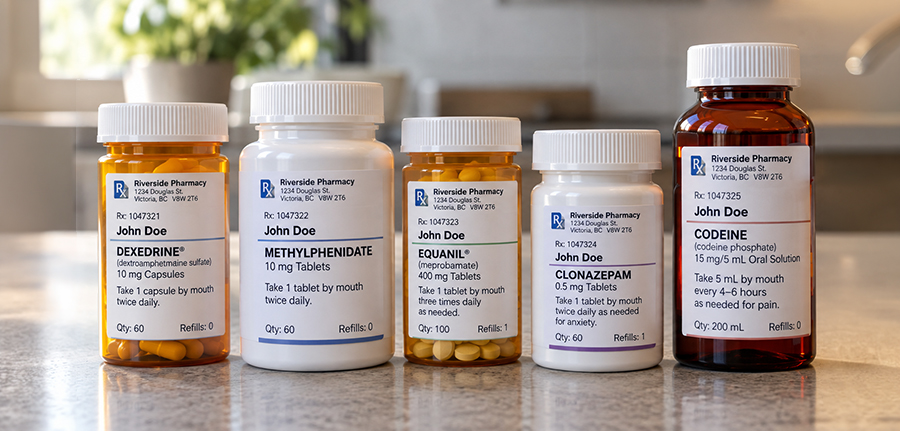
On October 4, 1965, Singer Johnny Cash was arrested at the El Paso airport in Texas in possession of 688 Dexedrine capsules (a stimulant) and 475 Equanil pills (a sedative) which he had imported illegally from Ciudad Juarez, just across the border in Mexico. In the movie quote, Cash defends his possession of such drugs to his first wife Vivian. His drug use was a major reason why their marriage ended a year later, a more costly penalty than the $1,000 fine and 30 day suspended sentence he was handed by the justice system.
Using drugs for their side effects
Cash began using Dexedrine to help deal with the exhaustion of touring, finding that it improved his mood and gave him the energy he lacked. Dexedrine is normally prescribed as a treatment for ADHD, narcolepsy or as an appetite suppressant. The medical system generally frowns on its use as a pep pill, to increase energy, wakefulness and expand the envelope of normal human function.
But what if a patient finds that the drug they are prescribed for a recognized condition also provides mood enhancing benefits? These benefits are extremely subjective and vary depending on the patient’s biopsychosocial makeup (their biology, psychology and the way life experience has molded them), so the effects of any drug are never wholly predictable. The medical system generally takes a risk/benefit approach to prescribing these drugs and assumes that the benefits generally outweigh the risks.
Pain killers, sedatives and stimulants all address maladies that cause suffering with the goal of restoring bodily and mental function to a point within the normal range. But the relief they provide a person can feel so liberating that the brain’s incentive and reward system sends them a powerful message: this feels good and I want more. This natural yearning fosters the pursuit of resources that promote good physical and mental health, but too much of a good thing can be dangerous. Even drinking too much water can be fatal. Drugs in these three classes commonly come with a warning label:
Take only as directed. Do not exceed the prescribed dose. Prolonged use may be habit forming.
Ignoring the warning signs
Should the patient decide to ignore this warning they are opening the lid of Pandora’s box. Exceeding the prescribed dose exhausts the supply before the prescription period has expired. At this point the patient must decide whether they can wait until the next prescription cycle or not (effectively adopting a binge–abstain pattern), or, if the cravings are too urgent, find an alternative source of supply. The distribution of these drugs is controlled by sophisticated tracking mechanisms in many countries, so maintaining a reliable supply can be challenging. Some options might include:
• Steal or buy the drug from friends or family members
• Subvert local tracking mechanisms by obtaining prescriptions online
• Turn to a black market supply of the drug
• Start using an illegal drug with similar effects
Drug use and misuse
These are not suggestions, but rather red flags. Moderate problematic alcohol consumption is sometimes described as grey-area drinking, but this terminology does not translate well in the prescription drug context. Using alcohol is a cultural norm in many countries, but the same cannot be said of using prescription drugs recreationally.
Moderate alcohol consumption is not misuse; using prescription medication other than as prescribed is. The term grey-area describes cases where the problematic nature of a person’s substance use is indeterminate. The phrase is commonly applied to the legal, but habitual, consumption of alcoholic beverages. The consumption guidelines provided by a physician, on the other hand, are an objective measure that eliminates this grey area entirely. This makes self-evaluation a simple task for those engaged in the unauthorized use of prescription drugs, but admitting there is a problem does not guarantee that the recovery process has begun.
Knowing something needs to change and knowing what to do about it are two very different things.
If your use of prescription drugs has begun to concern you—even if no one else knows about it—you do not have to wait until things get worse before talking to someone. As a recovery coach, I offer a confidential, non-judgmental space where you can talk openly about what is happening, explore what you want to change, and consider the options available to you. You do not need to arrive with a diagnosis, a label, or a commitment to abstinence. You can simply start with a conversation.
If you’re wondering whether your drug use has crossed a line, I would be glad to talk. Just drop me a note using the contact page at emergenthorizons.ca.

0 Comments